
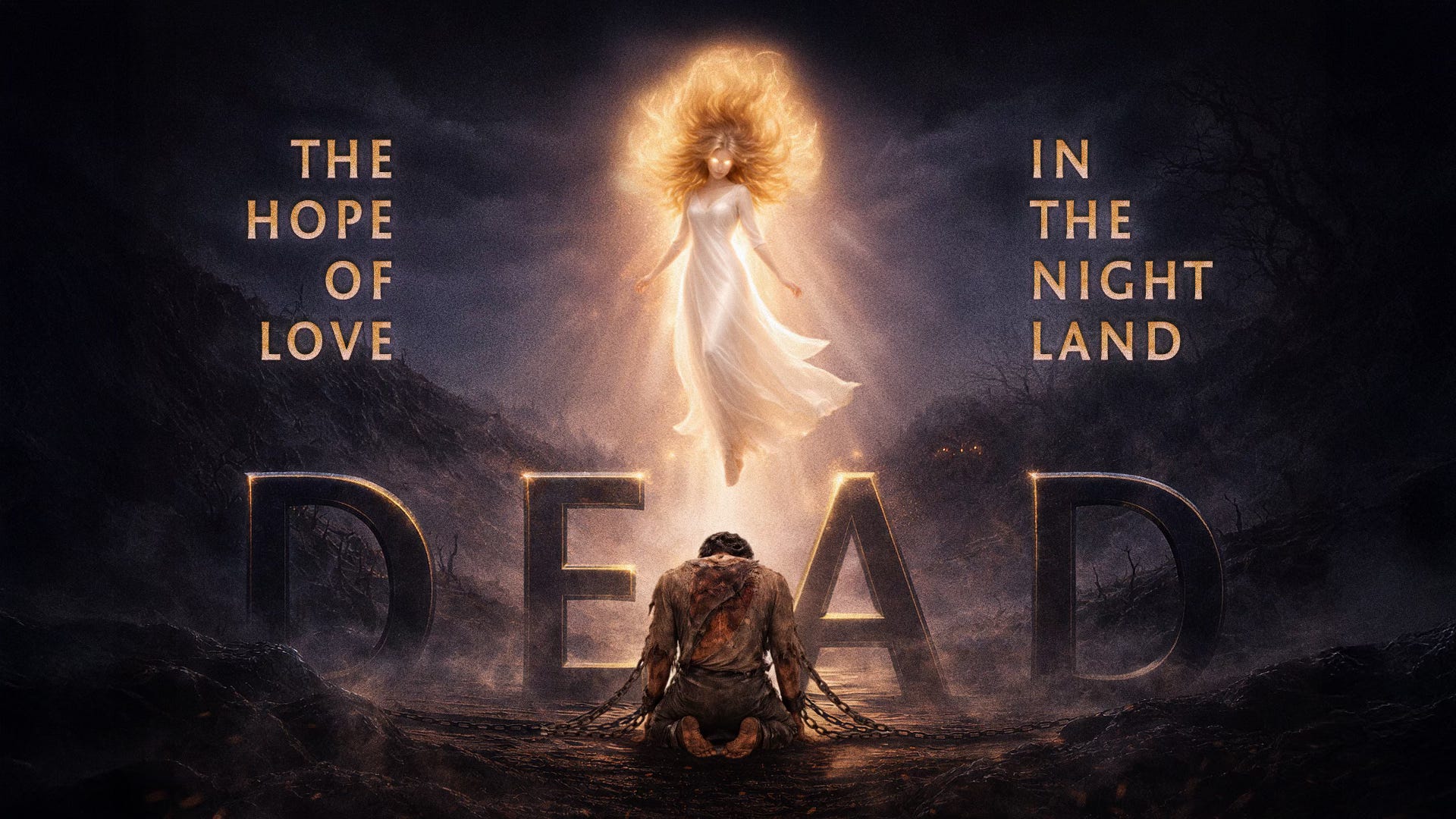
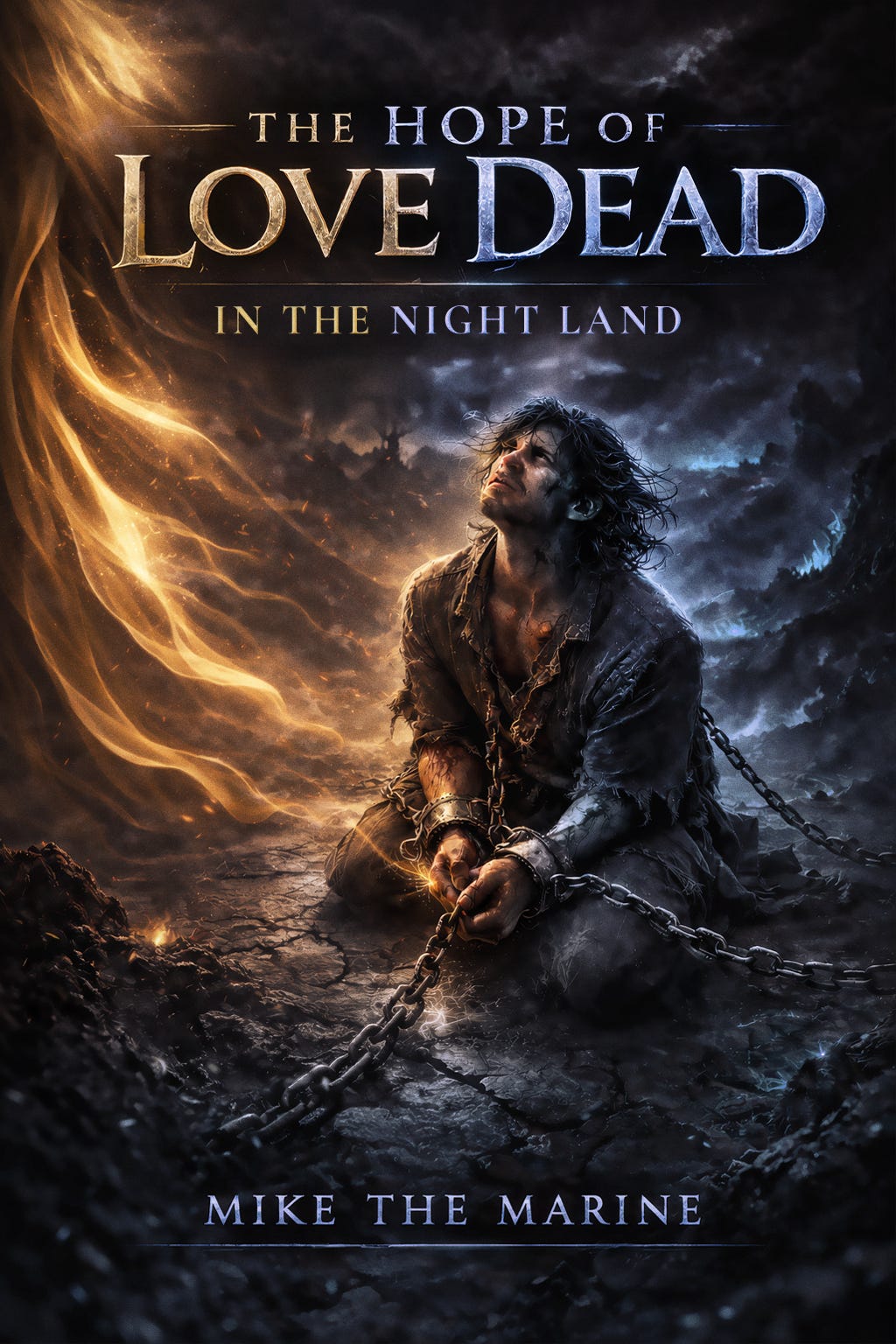
Hope of Love Dead in The Night Land
A Prisoner's Witness of the Night Land

Unto The Woman:
The Pure One,
Song always Young,
Crowned aught the Morn Dew,
Daughter born of Dawnlight Sun:

Love;

Thou art Kind,
And Patient;
Blood Rose in the Rains,
Shimmer of Light-pierced Waters,
Glow off the Face of God's Graces:

Lo! The Transcendent Spaces;

Wonder of our Cosmos high,
Ageless Heart who guards all Time,
Fidelis Shield of Star Fire,
Immutable Depths I desire;

Lord, such that She is,
I tremble and cry;
For distant She sits,
Her Beam brimming Life:

Serene o'er Scotland heathers;
The Psalms sewn soft through the Shaw,
Path ere the Eden of God;
Yore where mine Soul doth wish it trod:

Paradise...

But alow, veiled by this Vale,
The vile Cherubim bides,
Exiled from thy Heaven,
His knife gutting mine mind.

Afar beneath the Veld,
Such that Love could not see,
Sudden, He clutched ME,
I fell from the sight of Love Being:

Holy.

Set to ruin Her ever,
He made destruction of me,
And gloated the prize of Purity,
Be scorched out furtively.

In a Night Land, I wept,
Such bleak weeps of blood,
Held by chain-shackle melds,
Fixed by eyes red, like suns:

Sons unto the Farway Star who fell;
The Cosmic Traitor of Corruption.

Within this tragic World,
The Father allowed Him Power,
Levied with Legions and Lords,
By a Dark Council formed,
For a Dark Purpose—War.

From The Void, they connived,
Against Love ahigh,
To crucify Her Life,
In the Cold Dead of Night:

Lo, Our secret battle begins,
The curse of Man our instrument;
So shall the children of men murder innocence,
And by their COLD shall Divine Love end.

Us beasts and brutes,
Made foul in the curse of reproof,
Vow to make God undo,
Love promised to Man,
From the Watchers' gloried Youth:

Thus, we shall bruise Beauty,
And strip her bare to Blight,
And stain the children She carries;
Let Her travail with their cries.

And I, shall tread Her so!
And twist the skies unwise,
And lure Her body close,
And bleed Her neck dry.

And from brutal torture,
Mine Dark Captor arose;
The Morning Star loomed tall,
And He tempted the Lord:

O what now, Lord, of this man dying?
Where is the Love that could heal his mourns?
For his Joy seeps through the olden stones,
And his nerves expel such perfect groans!

I am It, I persist;
Ere Genesis, Enthroned!
The Opposer, of God,
The Composer, of Job;
Brightness Feared, Beauty Lorn,
Hear O Lord, Darkness ROARS:

Lo my Ode, fools and foes:
The Stone Throes, Sons of Woe!

Grazia writ—Sforzando:

The Forte Fist,
Swishhiss HIT.

Crack marrow—crescendo;
Slashhiss skin—da capo.

Shwa Bakh! Ha!
Thwkh Kha! Bo!
Shwa Basht! Lo!

Anima Mor—the coda.

Alas, Encore.

And so, his song persisted,
As if, pain had no end,
As if, Love ridded men,
As if, God did not live.

Melody maimed me,
Back bludgeoned by blared shrieks;
There, faintly, I breathed,
Hunched over, I ceased.

I bled without Love,
Abandoned to die,
Unworthy of else,
Blackened by crime.

But then—I saw Her faint ember,
Shine so great mine eyes dead could perceive;
The Holy Lady of Love,
Alighted the Night Land for me.

Her tendrils of Grace,
Stirred lights 'bout me bound;
Blurred beyond glow-haze,
Evil things hid crouched.

O, Precious, Golden Flower!
Hark wise Premonition,
All that is Good perishes here;
Frightened for Her, mine mind cried out,

Beware the Dark Scourers!

Yet, she could not hear this,
For mine tongue was without,
Being excised of it,
And so, muted from sound.

Please! God, no!
Behind her, they leap!
Please God...for me...
Do not let this be...

Let He them fly provincially;
And the Dogs pounced Love swiftly,
And drug Her down viciously;
The Land thundered wickedly.

Air gave rise in Her chest,
As her eyes veered left,
And watched me bereft,
As she breathed faint breaths.

Heat fumed from the hound-mouths,
And Great Growls to call their Master forth;
Many Shadows arose into Black Clouds,
Out of Hell born, The Macabre One formed:

THE DARK MAN—a surge-inverting Storm.

A Deep Hum from Him sounded,
And then vanished the dogs;
Vapor-made hands reached down,
And from one, a blade evolved.

Love laid still—Holy in Light,
Signet of Peace 'neath His Knife,
Yet the Most High let Him slice,
Ere Satan sundered her Guise.

And lo, thereby,
I watched Her die,
Without so much as a cry,
Save a lone tear shed from Her right eye.

I burnt lonesome inside,
And screamed with mine silence til I died,
For I suffered as Land suffered long,
Devoid of the Sun of Love to Shine.

Where doth Hope live?
Save the End of all of This,
But I was not fated that Bliss,
Save mine Mind to imagine It;

But perhaps, some other Man,
In a yet-gone Age of Time,
Shall see Love return to end,
The Evil of this Fright:

Love Dead in The Night Land.
From The Author
I began writing this poem at the outset of reading The Night Land by William Hope Hodgson. Before reaching a quarter of the way through, I had already drafted this poem, having been working on a lot of thematic writing exploring darkness and love. There was somewhat of a serendipitous nature to reading the book as it seemed to echo a lot of my own thoughts on its prevalent themes.
My reading of this Love Tale resulted from a self-directed imperative to read older and more obscure science fiction books. The Night Land surfaced after filtering through first recommendations of more mainstream varieties; and something about the name piqued my interest. So, I acquired a copy.
In early January, I started reading.
The preface poem struck me. Hodgson’s metaphysics were conveyed with an understanding and reverence that felt similar to my own. Something in the writing felt kindred; especially in the way it spoke of love. It seemed like I was meant to find it.
And sure enough, The Night Land fulfilled this uncanny crossroad; so much so, I researched the author. My connection to his writing was more than a fancy for its archaic or elegant prose. Hodgson’s age, life story, and interests bore a strong resemblance to my own. I found this astounding. Furthermore, the context of The Night Land made it even stranger, since it describes people being connected across space and time through signals.
Note: Before you run off into the night screaming about aliens, I’m not going to go into some reincarnation woo-woo about Planet X or the Anunnaki. Rest assured, I merely find the similarities between our life characters fascinating.
It goes without saying, all of this added considerable intrigue to my reading of Hodgson’s work.
By the end, I thought that The Night Land was an impressionable tale that left me feeling as if the story had taken place in the past rather than the future. Oddly enough, it did and it didn’t. At this point in the Present, it’s an interesting layer that didn’t exist in the Past since there was no one to read the book so far into the future. All these many years later, it feels like I am somehow apart of the story. Furthermore, the main characters were—in spiritual essence—time travelers from the days of old emitting Light into a Dark Future.
If you are unfamiliar with the book, I must tell you that the heart of the Story is Love.
The capital L version.
Love motivates Hodgson’s hero to go forth and do all that he does despite the bizarre and horrific nature of his environment. While reading the beginning chapter, I wondered how the origin story would transition into a futuristic dystopia as it read like an Elizabethan romance; I was in for a unique surprise as to how Hodgson accomplished this—the structure establishing a sensible framework for Love Eternal.
What is most profound about the love story in Hodgson’s tale is how it is defined—not just as a theoretical idea—but as a practice. Books today are rife with low-brow ‘romance’ but The Night Land delves into the places of love that no one goes because they are unable to. They lack the power and purity.
Given the fact the book was written circa 1912, it is less surprising that love is portrayed through a traditional lens; Hollywood and television programming hadn’t yet dug their claws into every crook and cranny of the human mind, mutilating and mutating it into a hyper-sexualized temple of hedonism.
Love here is a profound continuum through Space and Time everlasting. Without Love in Divine Form, the protagonist’s Fidelity could not exist. And there would be no impetus for his heroism—venturing out into a land of monstrosities to save his timeless Love.
For this Love to work, there must be a source and object of its transmission. In this story, Man to Woman. As Woman derives from Man, a special union exists in the dynamic of Love between both sexes that flows like AC current. It travels both ways.
When a component in that construction is out of order or damaged, the current cannot flow properly; nor can fruit grow without the water flowing.
Considering we live in a world where the word love is diluted, misused, and abused, it can be difficult, even improbable, to ever know and understand it as written in The Night Land. But it is that Light in the Night, that guides us Home. Without it, we are lost in the Dark.
Forever.
I come now to a revision of the commentary, having written the first part [Considering we live…] of the last section before finishing the book. I wondered whether Hodgson would address the perversions of Love and its true form eluding most people. Or if he’d focus solely on the ideal. But, no. He recognizes the alternate path—pain and sorrow; and renders it beautifully in a latter chapter, describing the very rarity of true Love and misfortunate prevalence of many never experiencing it in full.
Though, truly, there did go millions then, as now, that did never to know love; though the name did be in their mouths, and they to have belief that the sweet kernel did be in their hearts; but, in verity, this to be love, that your life shall bound in you with abundance, and joy dwell round you, and your spirit to live in a natural holiness with the Beloved, and your bodies to be a sweet and natural delight that shall never be lost of a lovely mystery that doth hold a perfect peace each unto the need of the other; and all to be that there go round about you a wonder and a splendour all the days and the nights that you shall be—the Man with the Woman, the Woman with the Man. And Shame to be unborn, and all things to go natural and wholesome, out of an utter greatness of understanding; and the Man to be an Hero and a Child before the Woman; and the Woman to be an Holy Light of the Spirit and an utter Companion and in the same time a glad Possession unto the Man.
Excerpt From
The Night Land
William Hope Hodgson
True examples of Love are hard to find in the shallow end of Time; and they can’t be bought or conjured. As History and Tale tell of Love, it comes from a depth too deep for most souls to access unless gifted entry.
Nevertheless, The Night Land enshrines Love in Pure form. Transcendent and Everlasting.
A 4th dimensional approach to the metaphysics in the book is analyzing it through the life of the author. Though named William, he was often called by his middle name Hope—and would be killed in action within six years of releasing The Night Land.
But the question is, did Hope die?
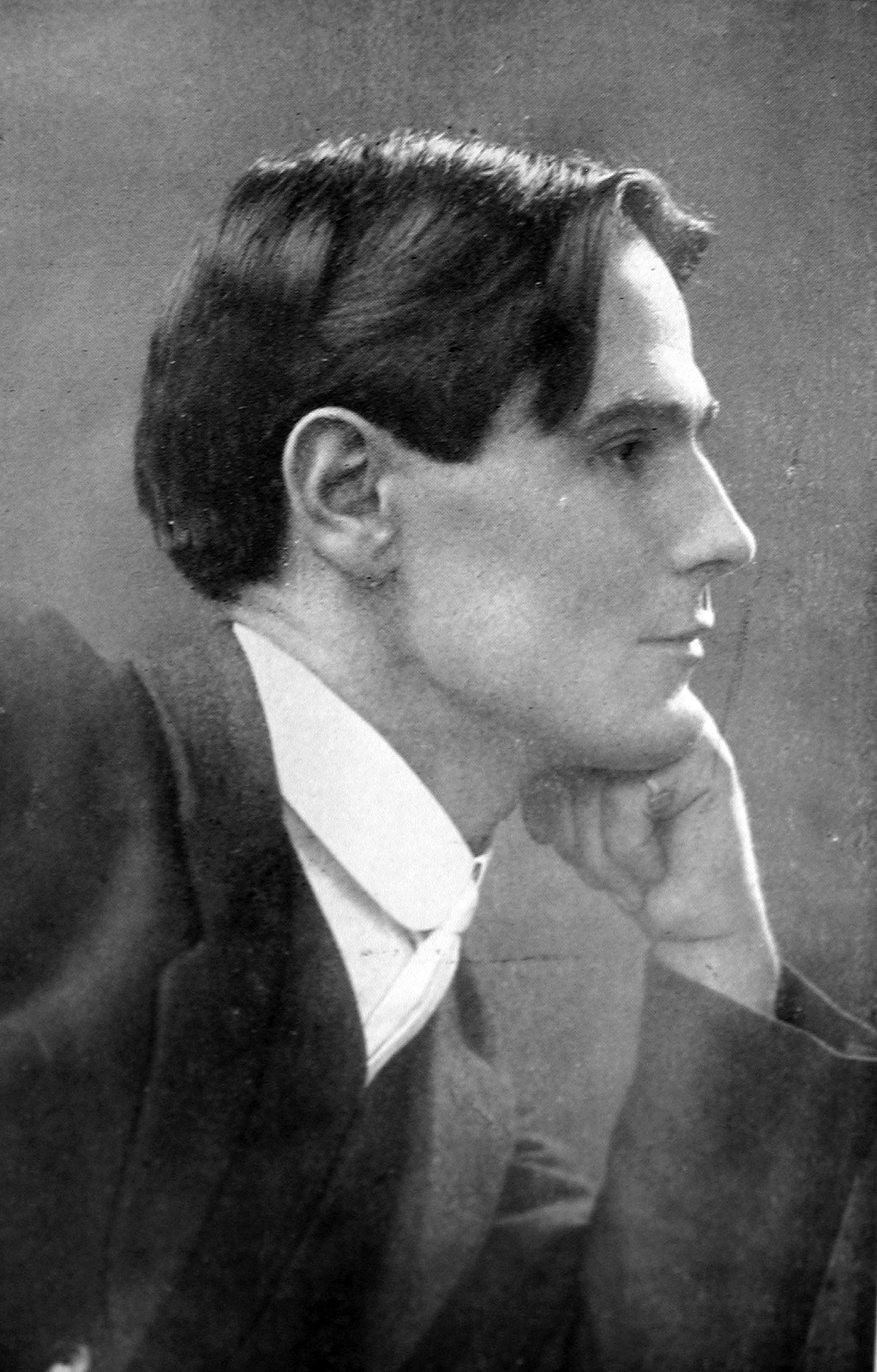
The body did.
However, his storied legacy has lived.
And so does his Love Tale that embodies Hope amid Darkness.
In Hodgson’s Day, the World experienced a Great Doom—the first World War. At present, we face a different beast—arguably, one darker and far more deceptive.
Though warfare has long since left the conventions of the Old World, its effects have not.
Bullets have upgraded to ballistic missiles.
Artillery has upgraded to nuclear arsenals.
The cost has been degrading.
Humanity has deformed.
The worst of bloodshed occurs in an unseen realm in the World—our minds; a constant stream of horrid things (monsters) barrage the natural Joy and Good gifted to us at the outset of life. In time, so much of it kills men with hopelessness and despondence; the truth in this can be elusive, as its wounds are often imperceptible, save for the emptiness within so many eyes.
Hope wrote The Night Land over 100 years ago. This poem is a tribute to that continuum. As the characters in the Story are bonded through the immutable nature of Love Eternal, so too am I connected to the voice and virtue of it. While aeons may pass between the seeming absence of Love, She is there awaiting resurrection by Her Love—The Husband (a part of the story I preempted here and ended up being right—incorporated by Hodgson in the finale).
Frighteningly, The Night Land exists—not in some hyperbolic futurism, but here and now, beneath the veil of a world that feigns good until the darkness plagues it again.
Hodgson wrote of this in a final letter1 written to his mother in 1918 while serving in the Royal Garrison Artillery of the British Army.2
The sun was pretty low as I came back, and far off across that desolation, here and there they showed—just formless, squarish, cornerless masses erected by man against the infernal Storm that sweeps for ever, night and day, day and night, across that most atrocious Plain of Destruction. My God! talk about a Lost World–talk about the end of the World … If I live and come somehow out of this (and certainly, please God, I shall and hope to), what a book I shall write if my old ‘ability’ with the pen has not forsaken me.
Within the borders of our Dark World, Love fades into the Dead Cold of Night. If left to the natural course of our worldly vices, Good would surely die. If not for the witness of Love Eternal somewhere beyond the Black of Night, awaiting rescue from the Evil surrounding Her, none would know She exists; and we would die fools in the lonely desperation of searching Her out.
Hope sacrificed his life in a battle reminiscent of the dark world he wrote of in The Night Land. According to record, all that was left of him to be identified was his helmet. Perhaps there is something to be said of that. I’ll leave you to think on it.
He and many others of that brave generation gave their lives to a cause they believed was greater than their own—out of Love.
Love for God.
Love for Country.
Love for Home.
This Love we have lost.
Hopefully, Hope is in Heaven. He struggled with God as evidenced in his other writings. And I understand that very well. Likewise, he never asserts outright disbelief. It could be gathered that he was not comfortable with unbelief in God, as a godly Love is sought amid great perils in The Night Land. Earlier in his letter, he even petitions God briefly—to be saved through the horror of war in his letter. Other works of his, like the poem, Bring Out Your Dead, contemplate the Lord’s Day of Judgement.
In my view, his strong, heartfelt writing on Love yearns for God deeply. Though I am not aware of any public profession of his faith, I believe he was knowledgable of the Truth as he was the son of a reverend. Nevertheless, he kept Hope alive, even if by a final breath because he couldn’t give up on it; he kept the Fire smoldering while attempting to reconcile the wickedness of a world ever clear and present to him.
But is that not the struggle of Faith? And the test we've all been given?
…to achieve the measure God has given.
Life trials are mysteries.
And not every seed we plant grows in the times of our aging eyes.
Good or bad.
We cannot see what we cannot see.
Nor what we are not allowed to.
Nevertheless, we can know of Love. Hope wrote of it strongly. And while some mysteries will remain mysteries, the mystery of Love has been revealed. The Night Land echoed this revelation through a Love Tale but it is only a mirrored image of The Love Story as accounted for in the Gospel of God.
God sent His Son into the Night Land to save us.
I don't know if Hodgson put his hope in Jesus. But I sure do hope so.
I can’t help but think that he aimed to be the man he imagined in the Night Land; and died a Hero with Honor.
Even his Commanding Officer wrote of him with great respect in a letter penned to his mother after his death.3
I cannot express my deep sympathy for you in your great bereavement. I feel it most terribly myself, and so do all the other officers and men of the battery. He was the life and soul of the mess—always so willing and cherry. Of his courage I can give no praise that is high enough. He was always volunteering for any dangerous duty, and it was owing to his entire lack of fear that he probably met his death on April 17. He had performed wonders of gallantry only a few days before, and it is a miracle that he survived that day. I myself am deeply grieved, having lost a real, true friend and a splendid officer.
As Time has revealed, there are those of us who still discover Hope amid a mire of modern muck—a diamond in the rough.
His fiction is all the more captivating because of his life story. And even if Hope could not see it, I live and breathe today, a future man reading of William Hope Hodgson in the second century of his legacy.
And considering our modern darkness, whereby we pain under sundry trials, his wisdom as gleaned in The Night Land resonates more heavily in our hearts.
It does in mine.
I can only hope that the good he brought to the fore in his writing will further echo in some of you.
I am hoping.
And so, Hope survives in death.
And as Eternity is the Horizon, we will always have Hope—for no Soul will ever meet Horizon’s end.
To close these matters on an uplifting note, I will conclude with Hodgson’s final words from The Night Land that farewell the journey of this brave hero and husband who sacrificed all for the sake of Love and Honor.
If there be anything left of conscience and virtue in the soul of Man, then these words should stir the Truth in you so long as the God of Love lives in your Heart.
And I to have gained Honour; yet to have learned that Honour doth be but as the ash of Life, if that you not to have Love. And I to have Love. And to have Love is to have all; for that which doth be truly love doth mother Honour and Faithfulness; and they three to build the House of Joy.
Read more about William Hope Hodgson.
Thanks for reading.
Do you know someone who would enjoy or appreciate this kind of poetry?
Share this with them.
All my writing here is free.
If you’d like to support the work, you can do so here:
Follow my YouTube channels:
Hodgson, William Hope. “A Letter from the WWI Front.” In Out of the Storm, edited by Sam Moskowitz, p. 115. Donald Grant, West Kingston, Rhode Island, 1975.
The Times Obituary: “Second Lieutenant W. Hope Hodgson, RFA, killed in action on April 17.” The Times, published May 2, 1918.
Stevens, O.S. “Letter to the Mother of William Hope Hodgson.” In Some Facts in the Case of William Hope Hodgson: Master of Fantasy by R. Alain Everts, Soft Books, 1987.